Fishing Charter SEO in the Age of AI Search
 By Paul Wingfield, founder
TLDR: Fishing charter SEO in 2026 means two things at once: ranking on Google and getting recommended by AI tools like ChatGPT, Perplexity, and Google AI Overviews. Both run on the same foundation. Specific, well-organized content about your charter, your target species, your waters, and your trips is what earns you visibility in either place. Generic content earns you neither.
Why This Matters Now
A few years ago, “SEO” meant one thing: rank higher on Google, get more clicks. That’s still true, but it’s not the whole picture anymore. A growing number of your future clients aren’t scrolling a results page at all. They’re asking an AI assistant “who’s a good redfish guide near Charleston” or “best offshore charter for a first-timer in the Gulf,” and getting a short, direct answer with two or three names in it.
If your charter isn’t clearly described online, in language that answers real questions, you won’t show up in either place. We’ve written before about how to get your tour or charter business recommended by ChatGPT and Google AI, and this article builds on that with SEO specifically. That’s the shift worth understanding before you spend another dollar on marketing.
The Numbers Behind the Shift
None of this is theoretical. Here’s what’s actually happened to search behavior over the past year or so.
Metric | Traditional Search | AI Search (2026) |
|---|---|---|
Where people start looking | Google search bar | 37% of consumers now start their search in an AI tool instead of a traditional search engine |
Click-through rate on the #1 result | 20–30% on competitive keywords | 8–12% when an AI Overview or AI answer is shown above it |
Searches ending with no click at all | Roughly 43% of all Google searches | As high as 93% when Google’s AI Mode is active |
Weekly active users, top platform | Google: still the largest search engine overall | ChatGPT: roughly 900 million to 1 billion weekly users in 2026, more than double a year earlier |
Share of research-type queries going to AI | N/A | Estimated 15–20% of informational queries as of early 2026, and growing |
Where AI answers pull their citations from | N/A | About 84% of AI citations come from third-party coverage (reviews, articles, directories), not a business’s own website |
A few sources disagree on the exact percentages, which is normal in a field this new. But every study points the same direction: fewer clicks on traditional results, more decisions getting made inside an AI answer before a website is ever visited.
For a charter business, the practical takeaway isn’t to panic and abandon SEO. It’s the last row in that table that matters most day to day: if AI tools are pulling most of their answers from outside sources, getting mentioned in reviews, local write-ups, and directories matters just as much now as what’s on your own site.
What SEO and AEO Actually Mean for a Charter Business
Traditional SEO is still the foundation. It’s the practice of structuring your website and content so search engines understand what you do, who you serve, and where you operate. Keywords still matter. So does site speed, mobile experience, and a clean site structure.
AEO, or Answer Engine Optimization, is the newer layer on top of that. AI tools don’t just crawl your site for keywords. They’re looking for clear, specific answers they can pull directly into a response. That means your content needs to actually answer the questions your potential clients are asking, not just mention the topic in passing.
The two aren’t in competition. A charter site built well for AEO is almost always well built for traditional SEO too. The difference is in how deliberately you write for the question, not just the topic.
Build Your Entity Network, Not Just a Keyword List
Here’s the shift in thinking. Old-school SEO advice tells you to find a keyword like “fishing charter Charleston SC” and repeat it a few times. AI search doesn’t work off single keywords. It works off relationships between related terms, what’s called an entity network.
Think about what naturally clusters around your business. If you run inshore trips in the Lowcountry, your entity network might include redfish, spotted seatrout, sight fishing, fly casting, the flats, tide charts, and specific creeks or inlets you fish. If you run offshore charters out of the Gulf, it’s mahi mahi, wahoo, trolling, bottom fishing, and specific named reefs or rigs.
When your content naturally includes this full web of related terms, in context, written by someone who actually knows the water, it signals real expertise. That’s what earns you a mention when someone asks an AI tool a question in your niche. Nobody else can write your entity network the way you can, because nobody else has actually run your trips.
Local SEO Still Carries Real Weight
None of this replaces the basics. Local SEO is still one of the highest-leverage things a charter operation can do.
Claim and fully complete your Google Business Profile. Keep your hours, service area, and photos current. Encourage clients to leave reviews after a good trip, and actually respond to them. Use location-specific language naturally in your content: the name of your marina, your launch point, the specific waters you fish. AI tools pull from the same signals Google does when it comes to local relevance, so this work pays twice. If you want to see how this plays out specifically for charter and guide businesses, our fishing guide and charter marketing page goes deeper.
Write Content That Answers Real Questions
If you want your content to earn AI citations, structure matters as much as substance. Lead with a direct answer to the question in the first sentence or two, the way this section does. Then support it with detail.
A blog post titled “What’s the Best Time of Year to Book an Inshore Trip” should answer that question in the first two sentences, then go deeper into the seasonal patterns, the species behavior, and what a client should expect. That structure is easy for a person to scan and easy for an AI model to lift and summarize accurately. If you want to check where your own site currently stands, here’s how to know if your outfitter website is ready for AI search.
A Real Example
Two of our clients, featured in our case studies, illustrate what this looks like when it’s done consistently.
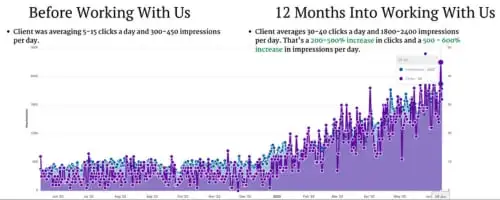
Bowman Fly Fishing started at 153 monthly website visitors and ranked for 220 keywords. After twelve months of steady, entity-rich content and local SEO work, they were pulling 688 monthly visitors and ranking for 897 keywords. Daily clicks went from single digits to 30 to 40 a day. That traffic contributed to more than $92,000 in booked trips over the year.
River Run Angling saw a similar arc. They started with about 8 daily visitors and a 56% engagement rate. A year later, they were seeing close to 45 daily visitors with a 92% engagement rate, and 62.5% of their bookings were coming directly from organic search. They went from one keyword on Google’s first page to 69.
Neither of these happened overnight, and neither happened by accident. Both took a full season of consistent, specific content before the results showed up. That’s the pattern worth expecting.
Common Mistakes Charter Owners Make
- Writing generic content. “Book your next fishing adventure today” could describe any charter anywhere. It doesn’t answer anything, so neither Google nor an AI tool has a reason to surface it.
- Skipping the direct answer. Burying your point three paragraphs deep, the way older SEO content often did, makes it harder for both readers and AI tools to find what they need.
- Ignoring Google Business Profile. This is often the single most overlooked, highest-impact piece of local visibility available to a charter business.
- Treating SEO as a one-time project. Both case studies above took twelve months of consistent work. SEO and AEO both reward businesses that stick with it.
- Writing for search engines instead of clients. The content that performs best reads like it was written by someone who actually knows the water, because it was. That authenticity is exactly what AI models are trained to recognize and prefer.
Quick Recap
- Click-through rates on top Google results have dropped from 20–30% to 8–12% as AI answers take over more searches, and around 84% of AI citations come from outside sources, not a business’s own site.
- SEO and AEO share the same foundation: specific, well-structured, expert content.
- Build your content around your entity network (species, techniques, locations) rather than a single keyword.
- Local SEO fundamentals, especially Google Business Profile and reviews, still carry serious weight.
- Lead with a direct answer, then add supporting detail, so both readers and AI tools can use what you wrote.
- Expect this to take a season of consistent effort. Both case studies here took roughly twelve months to fully compound.
If you’re not sure where your charter currently stands in AI search results, that’s worth finding out before you invest further. Take a look at our marketing packages to see how this fits together, or schedule a call with us and we’ll walk through it together.
More tips & how-to
How Do I Reduce My Dependence on Viator or GetYourGuide?
A step by step plan for tour operators who want more direct bookings and fewer commission fees, from the marketing crew that came out of the outfitting industry.
What’s the Difference Between AEO and GEO for the Outdoor Industry?
AEO and GEO are changing how people find outdoor businesses online. Learn what they mean, why they matter, and how to start optimizing your outfitter website so you show up when it counts.
2026 State of the Industry | Outdoor Travel & Marketing Trends
The latest data on outdoor recreation, AI search, and booking trends for 2026, and what it means for tour operators, guides, and outfitters.